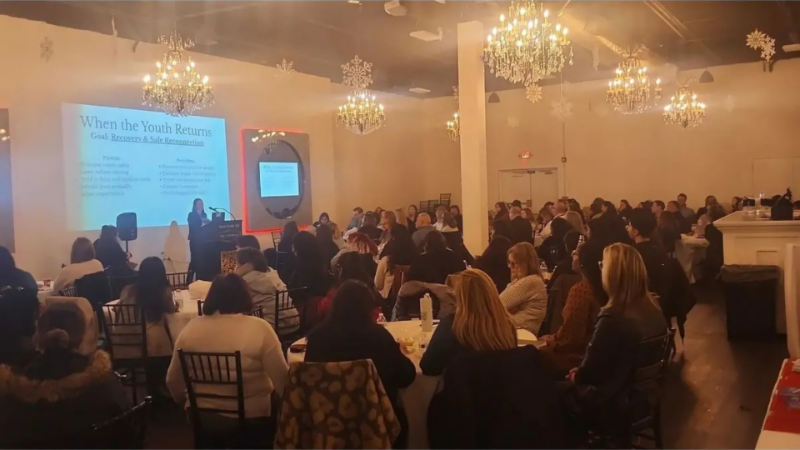
The event on Friday, Jan. 16, the "Shining a Light on Human Trafficking" conference, was hosted by EAC Network’s Safe Harbour program in partnership with Nassau and Suffolk counterparts.
EAC Network Suffolk Safe Harbour Program Supervisor Stephanie Muller said the 2026 gathering marked the fourth annual conference — and the first to be formally joined with Nassau’s Safe Harbour program under EAC’s expanded oversight.
Missing and runaway youth can quickly become targets for exploitation, those speaking explained, and the choices adults make in the hours and days after a youth returns can shape whether reunification becomes recovery — or another disappearance.
Speakers presented throughout the day, with programming focused on one particularly high-risk pathway into exploitation — missing and runaway youth.
Amanda Polina, a licensed social worker and counselor at The Retreat — a nonprofit organization in East Hampton that provides free, confidential support, counseling, emergency shelter, and legal assistance to victims of domestic violence, sexual assault, and human trafficking across Long Island — presented on trauma and neurobiology, asking attendees to look past labels and ask what comes before a runaway episode.
Participants raised factors such as domestic violence, neglect, and the absence of stable attachment, and Polina stressed how those early experiences can shape a child’s self-worth and decision-making.
“Kids will look to anyone that they feel is an adult that they can maybe hang around and try and get that attachment with,” Polina said, describing how messages learned through exploitation can become internalized rules for survival — including the belief that a body can become currency.
Polina explained that trauma can fundamentally change how the brain and nervous system function. The prefrontal cortex — the brain’s logic and decision-making center, which is still developing in adolescence — can become less effective after severe trauma, impairing emotional regulation, judgment, and problem-solving. She also described how the amygdala, associated with fight-or-flight responses, can become locked in a state of hypervigilance, fueling anxiety, fear, and sometimes aggression.
She described the hippocampus, responsible for memory processing, as a “USB” that can be disrupted by trauma, leaving survivors with fragmented recall that can complicate healing and even legal processes.
Polina also walked attendees through survival responses that appear in trafficking dynamics, including “fawning” — mirroring behaviors and abandoning boundaries to reduce danger — and “collapse,” which she described as a shutdown response aimed at surviving a threat.
Many professionals in the room, from schools to social services to law enforcement, are the people youth and families encounter after a runaway episode, and speakers warned that the wrong interaction can cause families to shut down — or lead a youth to disappear again.
April Zimmerman, a senior clinician at The Retreat, framed the issue in terms of response and reunification.
“We want to really be mindful of parent response and provider support, because it really directly influences the safety process,” Zimmerman said, warning that negative system interactions can prevent families from seeking help.
She described how repeated runaway episodes can alter a household’s emotional rhythm and encouraged professionals to approach parents without judgment, help them navigate fragmented systems, and prepare them for reunification in ways that reduce punitive reactions and strengthen connection.
Muller said the focus this year was missing and runaway youth because of their heightened vulnerability to exploitation and that the conference blended national expertise, survivor perspectives, and local practice.
In discussing how Long Island compares to other regions, Muller said trafficking is a “hot spot” locally and argued that disbelief remains a major barrier. She pointed to online grooming as a primary pathway into exploitation, stressing that it can begin on virtually any platform — not just the largest social media sites.
“People think, like, maybe it’s just Facebook, maybe it’s just Instagram, but any app can really be used to connect,” Muller said, listing examples ranging from Discord and Roblox to Reddit and noting that some youth also wind up on dating apps. Even when exploitation occurs offline, she said, grooming often happens online.
Muller also challenged the misconception that trafficking typically involves abduction.
“It’s not often an abduction situation,” she said. “A lot of the times the trafficker is building that relationship and building that bond, and that’s more effective for the trafficker, because if I have mental chains on you, those are harder to break.”
She said trauma bonds and vulnerabilities can keep a young person attached even when they recognize danger, while identification remains a constant challenge because reported numbers reflect only those youth who come into contact with systems and services.
Safe Harbour typically serves youth beginning around age 12 through young adulthood, up to age 21. In Suffolk County, Muller said the program worked with 188 youth in the past year, cautioning that the real scope is larger because many victims are never identified or referred.
Cases can involve very young children. Muller said the program has had cases “as young as… 11,” while noting that the broader child advocacy system encounters abuse cases at even younger ages.
Another factor that can keep victims hidden is trafficking within the family.
“Familial trafficking is a concern,” Muller said. “Forty percent of child sex trafficking cases are actually controlled by the family,” which she said can make it harder for outside programs to gain access — one reason her team places heavy emphasis on school-based outreach and education.
From law enforcement, Suffolk County Police Lt. Frank Messana, a 22-year veteran of the department, described trafficking investigations as complex, often lengthy, and dependent on building trust with victims who may be reluctant — or afraid — to come forward.
“Sex trafficking is always there,” Messana said. “It comes down to what we can uncover — what kind of victims we can get to come forward. It’s definitely prevalent in Suffolk County. It’s a problem that a lot of people don’t want to acknowledge that we have here. But we do. We have a unit dedicated just to investigating human trafficking, and they are always busy.”
Messana said the department has focused specifically on trafficking investigations since 2018. When asked why the issue persists on Long Island, he cited conditions that can create opportunity for traffickers without pointing to a single cause.
“We have a lot of hotels — proximity to the city, suburban area,” he said, adding that the opioid epidemic and substance abuse play a significant role.
“The investigations into human trafficking are very complex,” Messana said. “A lot of the victims don’t necessarily want to come forward right away. Taking care of the victim, making sure they’re on the right path first — and then if we can get the bad guy, even better.”
He said cases often require corroboration beyond a victim’s account. “We need a lot of corroborating evidence, because it can’t be just what the victim says,” Messana said.
Most cases involve people “anywhere between 16 and 23,” Messana said, but many victims report being drawn in much younger. “A lot of the girls that we do deal with talk about their getting into life at 12, 13,” he said.
Conference organizers said that partnerships with law enforcement are critical in trafficking cases, particularly when police alone cannot provide every form of support needed to stabilize a victim. Advocates and service providers fill essential gaps.
“We’re cops — we only have so many tools in our tool belt,” Messana said. “Advocates, Safe Harbour, the EAC Network — they’re the lifeline that we need.”
New York Assemblymember Steve Stern, who spoke at the conference, also spoke with Patch about what he described as two core needs in addressing trafficking: awareness and resources.
“There still are way too many of our neighbors who are not aware of this as an ongoing major issue that is going on right next door to their homes and their businesses,” Stern said. “You can’t say that it’s not happening in my zip code, because the next-door zip code is five minutes away. This is an issue that impacts all of us.”
Stern said state policy efforts aimed at changing how victims are treated — and how communities are trained to identify trafficking — are moving forward. Recent and pending legislation, he said, reflects a shift toward treating trafficking survivors as victims rather than criminals while expanding who is responsible for recognizing and reporting exploitation.
A law recently signed by the governor will change how prostitution-related cases involving trafficking victims are handled.
Bill A1029-B / S3967-B, sponsored by Assemblymember Anna Kelles and Senator Luis Sepúlveda, passed both chambers and was signed into law by Gov. Kathy Hochul in late December 2025.
Under the new law, individuals exploited through trafficking can no longer be prosecuted for prostitution-related offenses tied to that exploitation — a change Stern said removes one of the largest barriers to cooperation with law enforcement.
“Vulnerability does not equate to culpability,” Stern said. “Too many of those that are forced into a life of prostitution are themselves victims, and if that is their situation, they cannot and should not be prosecuted like criminals.”
A separate bill introduced by Assemblymember Jessica Gonzalez-Rojas would require commercial truck drivers to receive trafficking awareness training, citing rest stops and transit corridors as frequent sites of exploitation.
“Anything that we can and should be doing to continue to raise awareness and pinpoint those areas of greater likelihood of sex trafficking is going to be something that we all have a role to play in,” Stern said.
Stern said he would like to see similar requirements eventually extend to other transportation-based services, including rideshare companies, arguing that early recognition by people on the front lines can disrupt trafficking before it escalates. He also said efforts to strengthen online safety for youth are essential as trafficking increasingly begins in digital spaces.
“Our local law enforcement has done an outstanding job focusing on this issue,” Stern said. “They are ready, willing, and able to provide guidance and resources, but it only works if all levels of government are aligned and supporting that effort. Only with a coordinated effort — local, county, state — can we make the kind of impact that we desperately have to have."
Source: https://patch.com/new-york/hauppauge/shining-light-human-trafficking-long-island